How to Stop Living Inside Your Head and Actually Take Action
What neuroscience and spirituality agree on about breaking the mental loops that keep us stuck
1. Why Do Different Roads Lead to the Same Place?
Whether someone experiences an epiphany, deep meditation, severe trauma, or a medical crisis (like near-death or flatlining), they often end up feeling the exact same thing: a sense of pure unity, time stopping, and the ego disappearing.
Why it happens: All of these vastly different events temporarily shut down or bypass the exact same part of your brain—the Default Mode Network (DMN). This network is your brain’s “self-engine.” It’s what builds your ego, separates “you” from “everyone else,” and runs your internal script.
The Result: When you cut power to that engine—whether by melting the glass with insight or smashing it with shock—the self dissolves. What’s left underneath is pure, unconditioned awareness.
2. The Illusion of Linear Time
We think time is a strict physical law, but our daily experience of time is actually a trick played by our memory and predictions.
How the brain makes time: Your brain constantly looks backward into memory (”Where I just was”) and forward into expectation (”Where I am going”). The line it draws between those two is what feels like “linear time.”
What happens when the tracking stops: When your brain stops running that memory-and-prediction loop, the timeline collapses.
Example: During an epiphany or shock, time might feel like it’s running on fast-forward, or hours can feel like a single, frozen, eternal “now.” There is no past or future—only the immediate present.
3. From “One Person” to “Anyone” to “Everyone”
When your standard identity falls away, your relationship to humanity completely shifts:
No One: You realize your ego (your name, your history, your daily worries) isn’t a solid, fixed object. It’s just an outfit you’re wearing. Without it, you are “no one”—meaning you are free from having to constantly protect a rigid persona.
Anyone & Everyone: If your personality is just a product of your specific DNA, memories, and environment, what is left when you strip those away? Just raw awareness. You realize that the same awareness looking out of your eyes is what animates everyone else. If you had someone else’s exact life and brain, you would be them.
4. The Trap of Practical Limitations
Seeing infinity is incredible, but then you have to wake up and live a real human life, which can feel frustrating.
The Friction: You might realize in a moment of clarity that you could theoretically learn any skill or be any kind of person (like a brilliant artist), but in daily reality, you have limited time, specific skills, and bills to pay (like working as an accountant or engineer).
Why the limitation matters: Absolute infinity cannot paint a picture. To experience anything in physical reality, you need boundaries. Your specific limitations and choices are the canvas that gives your life shape, texture, and meaning.
5. Dropping the Script and Taking Action Right Now
Before an awakening, your brain uses identity as a rulebook to keep you stuck: “I don’t do that,” “I’m not the type of person who can achieve this.”
Breaking the Permission Slip: When the ego filter drops, you stop asking your self-image for permission.
Action First, Identity Later: Instead of needing an identity that matches an action before you do it, you realize you can just act.
Example: If you want to start a brand new project, learn a complex skill, or try something totally out of character, you don’t negotiate with your old script—you just start right there and then.
6. The Whole Human Spectrum
When you stop trying to protect a fragile identity, you stop fearing extremes.
Embracing the Full Range: You realize you don’t have to stay neatly trapped in the “safe middle.” You can experience joy, mastery, and flow, but you can also experience grief, failure, confusion, or messiness without panicking.
Not Fixed: You are not a static monument carved in stone. You are a fluid, unfolding process.
7. The Trap of Judgment and the Time Delay
Why are people on social media or in daily life so brutally judgmental when someone doesn’t fit the “norm”? Because judgment of another is judgment of self, disguised by a tricky time delay.
Step 1 (The Outward Disgust): When someone sees a person breaking a rule or being messy, their ego feels threatened. To feel safe, they hurl disgust outward: “Look at them. They shouldn’t be like that.” In that second, it feels empowering.
Step 2 (The Inward Shame): Because the mind uses the exact same rules for self as it does for others, that exact same rigid standard comes back to haunt them later when they inevitably mess up. It hits them as shame: “I’m foolish. I failed.”
The Trick: Because the disgust happened on Tuesday and the shame happened on Friday, we miss the connection. We don’t realize the weapon we used on someone else is the exact weapon that just hit us. Once you drop the disgust toward others, the shame toward yourself starves to death.
8. The Map of Growth: Moving Up the Hawkins Scale
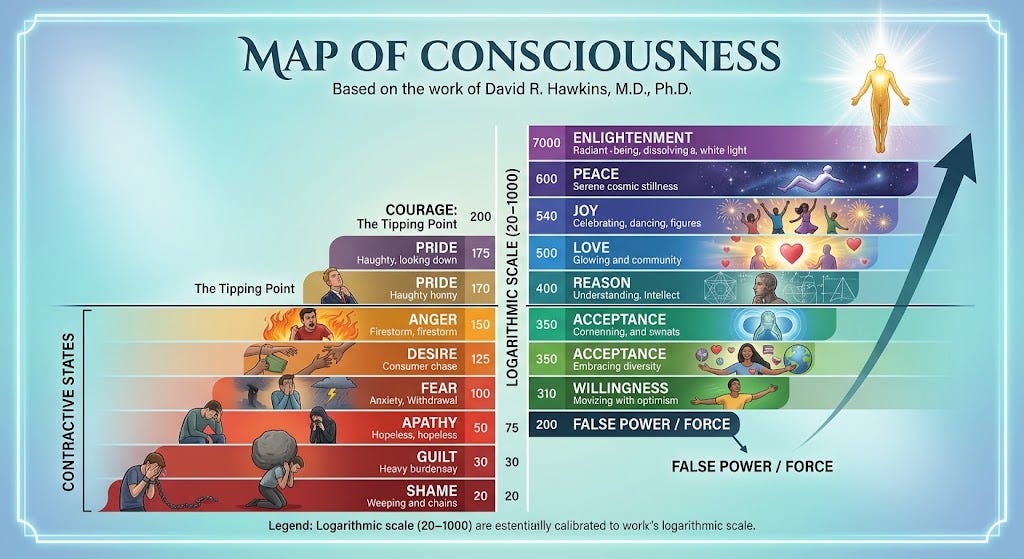
As we unpack these shifts, we map out how human consciousness moves from heavy, defensive living into absolute freedom. Based on David Hawkins’ scale of consciousness (Power vs. Force), moving through these realizations means stepping up through several key levels:
Courage (Log 200): The critical tipping point. This is where you realize you aren’t a victim of your past identity. You drop internal resistance and find the boldness to take new actions right now.
Willingness (Log 310): Letting go of pride or the need to already be “good” at something. You become simply willing to engage with life and try things without needing a permission slip.
Acceptance (Log 350): Taking full ownership of your experience without judgment. You accept that the good, the bad, and the messy are all valid parts of being human, and you stop demanding perfection from yourself or the world.
Reason / Understanding (Log 400): Deconstructing the mechanics of your own mind—seeing how time, predictive identity scripts, and the “judgment blocker” actually work.
Love & Peace (Log 500–600): Moving beyond the small ego entirely, realizing the deep interconnectedness of all people (”everyone is just you in a different outfit”), and resting in unitive awareness where linear time dissolves.
9. Returning to Earth: The Ongoing Practice & Biology of Fluidity
You don’t stay on top of the mountain forever. Daily life happens down in the valley, and old identity habits or fears inevitably creep back in.
The Ego Rubber-Band: Even with deep understanding, old brain scripts will occasionally snap back. Sometimes they even sneak in disguised as self-criticism: “I shouldn’t feel afraid or judgmental right now since I know better!” (Which is just another judgment).
The Real Work: Having the understanding is having the blueprint. Building new habits is building the house. You don’t have to be enlightened 24/7. You just notice old patterns without beating yourself up, and gently choose a new action one step at a time.
The Ultimate Proof: Epigenetics
This fluidity isn’t just psychological—it goes all the way down to our biology. We are taught to think our genetics are a fixed life sentence (e.g., “I’ve just had severe period cramps for over a decade, that’s just how my body is”). But epigenetics proves that DNA is a dynamic script, not a prison.
When you change your inputs—like starting a new natural supplement protocol—you can literally send signals to your cells to turn off inflammatory pathways and turn on healing ones. Going through a physical shift like that, where a decade-old pain completely vanishes, shatters the ultimate limiting story: You are not fixed.
If a biological pattern running for ten years can completely transform with a new protocol, it proves that every part of you—mental, psychological, and physical—is fluid, adaptable, and capable of a total reset the moment you change what you’re doing.
How does this final version look for sending off to your friend?
By Florence
Writing at the intersection of AI and inner life
New essays on consciousness, technology, and what it means to be human — delivered to your inbox.
Subscribe free