
Why Smart People Can't Think Their Way to Peace
How over-relying on intellect blocks emotional and spiritual growth — and what to do instead
Have you ever felt like you’ve figured out how to think through almost everything in your life, yet somehow genuine peace still feels out of reach?
You can explain your choices, justify your boundaries, and analyze your feelings down to the exact cause. You’re smart, logical, and capable. But beneath all that clear thinking, there’s often a quiet, lingering tension—a feeling that despite doing all the “right” mental work, love, joy, and stillness are just fleeting guests rather than where you actually live.
The instinct when this happens is to try to think harder. Read another book, analyze the problem a bit more, find a better explanation.
But what if logic isn’t the solution? What if the very thing you’ve been relying on to protect yourself and make sense of the world—your need to rationalize everything—is actually the wall keeping you trapped?
To see why this happens, it helps to look at two big ideas about how humans grow: Abraham Maslow’s famous ladder of human needs, and David Hawkins’ map of human awareness. When you put them side by side, a clear pattern emerges. It turns out that being extremely logical isn’t the end of the road. It’s just a pitstop—and staying there too long turns reason into a prison.
The Ladder We All Know (And the Rung Maslow Left Behind)
We’ve all seen Abraham Maslow’s hierarchy of needs at some point—that classic pyramid starting with basic survival and working its way up to “Self-Actualization.” (If you want to look at where it all started, you can read Maslow’s original 1943 paper, A Theory of Human Motivation).
For decades, we’ve been told that Self-Actualization is the ultimate goal. It’s the level where you figure yourself out, master your skills, live autonomously, and realize your potential. It’s the dream of modern self-development: becoming the best, most optimized version of yourself.
But late in his life, right before he passed away, Maslow realized something critical: Self-Actualization wasn’t the top of the mountain.
He noticed that the people who were truly fulfilled—the ones who carried a deep, unwavering sense of peace—didn’t just realize their own potential. At some point, they surrendered their ego to something larger than themselves.
So, he quietly revised his model and added a final tier above Self-Actualization: Self-Transcendence. (You can explore more on his late-life writings via the Journal of Humanistic Psychology, where researchers digitized his late work).
                           MASLOW'S REVISED MODEL
                        ┌───────────────────────────┐
                        │    Self-Transcendence     │  <-- The Forgotten Peak
                        ├───────────────────────────┤
                        │     Self-Actualization    │  <-- Where Most Stop
                        ├───────────────────────────┤
                        │       Esteem Needs        │
                        ├───────────────────────────┤
                        │     Love & Belonging      │
                        ├───────────────────────────┤
                        │       Safety Needs        │
                        ├───────────────────────────┤
                        │    Physiological Needs    │
                        └───────────────────────────┘
Self-Actualization is about building a strong, successful “me.”
Self-Transcendence is about moving beyond the “me” entirely.
In Self-Transcendence, your focus shifts from “How do I achieve my potential and control my world?” to “How am I connected to everything around me?” It’s where personal ambition softens into service, presence, and non-conditional love.
Yet, most of us were only ever taught to climb to Self-Actualization. We built the strong ego, mastered the skills, and polished our logic—and then wondered why we hit an invisible ceiling.
Mapping the Energy of the Mind (Dr. David R. Hawkins)
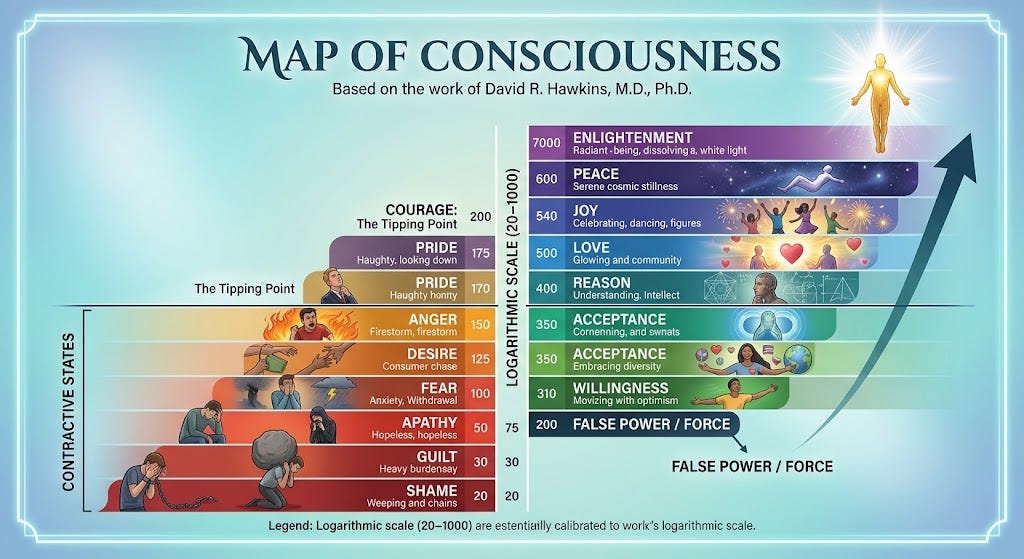
To understand why we get stuck at that ceiling, we have to look at another blueprint: Dr. David R. Hawkins’ Map of Consciousness. (You can inspect the full breakdown and calibration chart on the Veritas Publishing Official Hawkins Site).
Instead of focusing on what drives us (like Maslow), Hawkins mapped how we experience reality based on our emotional states and energy calibrations, on a scale from 1 to 1000.
When you look at Hawkins’ scale—a cornerstone concept in modern Transpersonal Psychology—it follows the exact same journey as Maslow’s ladder, but it reveals the emotional “frequency” behind each step:
Survival & Protection (<200): States like Shame, Guilt, Apathy, Fear, and Pride. Here, energy is primarily consumed by self-protection, navigating painful emotional weight, and trying to stay safe in a heavy world.
Reclaiming Agency (200–350): Reaching Courage, Neutrality, and Acceptance. This is where a gentle shift happens—where you begin to trust yourself, develop inner resilience, build authentic connections, and realize you have the power to shape your own life.
The Intellect (400s): The realm of Reason. Logic, understanding, problem-solving, and personal mastery. This is where Self-Actualization lives.
Transcendence (500+): Unconditional Love (500), Joy (540), Peace (600), and Enlightenment (700+).
When you layer Hawkins’ map over Maslow’s revised pyramid, something striking happens:
Maslow’s Self-Actualization sits squarely at Reason (400).
Maslow’s Self-Transcendence opens up at Love, Joy, and Peace (500+).
And right between them sits the greatest hurdle of all: The Trap of Pure Logic.
Dante’s Allegory: Why Virgil Couldn’t Enter Paradise
This pattern isn’t new. Centuries before Maslow or Hawkins mapped the human psyche, Dante Alighieri charted the exact same journey in his 14th-century epic, The Divine Comedy.
Dante’s trek through the afterlife mirrors the evolution of human consciousness:
Inferno (Hell): Wandering through raw suffering, shame, guilt, and survival—the chaotic energies calibrating below 200.
Purgatorio (Purgatory): The arduous climb of self-discipline, reclaiming agency, and cleansing emotional baggage—moving through Courage, Neutrality, and Acceptance (200–350).
Paradiso (Heaven): Stepping into pure illumination, unconditional love, joy, and non-dual peace (500+).
   DANTE'S TRILOGY                 THE GUIDE                 HAWKINS / MASLOW
 ┌─────────────────┐       ┌──────────────────────┐    ┌───────────────────────────┐
 │    Paradiso     │  ──►  │       BEATRICE       │ ── │   Self-Transcendence      │
 │    (Heaven)     │       │ (Love, Faith, Grace) │    │   Love & Peace (500+)     │
 ├─────────────────┤       ├──────────────────────┤    ├───────────────────────────┤
 │   Purgatorio    │       │       VIRGIL         │    │   Self-Actualization      │
 │   & Inferno     │  ──►  │    (Human Reason     │ ── │   Reason & Logic (400s)   │
 │ (Earth & Hell)  │       │    & Intellect)      │    │   Basic Needs (< 350)     │
 └─────────────────┘       └──────────────────────┘    └───────────────────────────┘
The most striking part of Dante’s story is who guides him.
To navigate the horrors of Hell and climb the mountain of Purgatory, Dante is led by Virgil—the great poet who represents the pinnacle of human reason, intellect, and worldly wisdom. Virgil is brilliant, steady, and protective. He helps Dante analyze the roots of human missteps and master his own mind.
But when Dante finally reaches the threshold of Paradiso, something heartbreaking happens: Virgil vanishes.
Virgil cannot step into Paradise. Why? Because in Dante’s worldview, pure intellect and human logic can only take you to the edge of the sacred. Reason can help you understand your pain, navigate the earth, and build a sane, self-actualized life—but it cannot take you across the threshold into pure bliss.
To enter Paradiso, Dante has to bid farewell to Virgil and surrender to Beatrice, who represents heart-centered intuition, divine grace, and transcendent love.
The Gilded Cage of Reason
This brings us right back to our everyday lives.
Many of us are living with Virgil as our permanent master. We’ve crowned Reason (400) as God. We use logic to solve every emotional problem, analyze our past, and attempt to design our peace.
Virgil has done a wonderful job: he helped us survive the chaos of our lower emotional states (<200), guided us into self-mastery, and helped us become competent, actualized adults.
But when we try to force Virgil to guide us into unconditional Love, Joy, and Peace (500+), he fails. Logic tries to measure, categorize, and control—while peace requires us to soften, surrender, and let go of control.
When you treat reason as the ceiling of reality, it stops being a helpful guide and turns into a gilded cage. You become high-functioning, incredibly logical, and impeccably analytical... yet strangely insulated from the warmth of your own heart.
So, if reason alone can’t open the door to transcendence, why do so many smart people get stuck here? And more importantly—how do we step beyond Virgil’s guidance without losing our minds in the process?
In Part 2, we’ll explore how hyper-rationality becomes an emotional armor, why being “irrational” is actually the secret key to self-esteem, and how to uncover the baseline peace that was already yours to begin with.
By Florence
Writing at the intersection of AI and inner life
New essays on consciousness, technology, and what it means to be human — delivered to your inbox.
Subscribe free